Monday, March 5, 2012

olive-tini

This has zero to do with homesteading or Tennessee, but I had to share pictures I took of my adorable three-week-old niece, Olive, yesterday. Stephanie's idea (her mom) was to dress her in an olive-colored onesie with a red knit hat and sit her in a giant martini glass for the birth announcement. Funny how a red hat proved elusive but she was able to hunt down a giant martini glass, but I still think we got the bow positioned right (and not "douchey-looking", lol, per Steph) as a nod to the pimento. I'm no Anne Geddes, but it was pretty fun to shoot, although we were both extremely nervous to take our hands off that martini glass! Mom's hands were literally an inch out of each frame.

An overhead airplane kept her entertained while I frantically tried
to get as many shots as I could before she tried to move!
I did remove a booger from her nose during processing
in The Gimp (aka poor man's Photoshop).

It topped out at 83 degrees in Santa Cruz on Sunday. I'm thrilled
that our last winter in California has been so spectacular.

Gratuitous nekkid baby shot.

Sadie is not real sure what the purpose of
this "new thing" is and quickly exited the room.

Friday, March 2, 2012

future farm critters - part 5: chickens

As you might already know, I currently have two chickens: Del, a Delaware, and Jersey, a Black Jersey Giant. Such original names. Del and Jersey have been turned into pets and will live out their lives in chicken paradise, doing whatever they want, because they've been pardoned for ridiculous reasons I won't go into here again. Even so, it's been somewhat hard to not eat Jersey because she is a really big girl and would probably be quite delicious - she's only really been spared because Del would be lonely without her. I might want to get more Jersey Giants in the future because she (and Del actually) has proved to be quite the active forager in my small backyard.

What is wrong with this picture?
(She, of course, pooped immediately after this picture was taken.)

Anyway, for my future broilers, there are a few other varieties that I'm particularly interested in. While I do want eggs, quantity is not really an issue because Jay doesn't even eat eggs, and I'm more interested in egg aesthetics anyway (aesthetics seems to be a recurring trend with me, I know - plus I like saying aesthetics). I want those fancy blue eggs. In researching the fancy blue eggs that come from Ameraucanas, I also came to discover fancy dark brown eggs. There are also olive eggs that are the result of mixing the previous two. This is what I'm talking about, people. I am easily charmed by pretty colors, and I intend for my chicken fleet... er, flock... to reflect that.

What can I say, it's the artist in me that adores this.
[ image source ]

I'm not going to delve into the whole Araucana/Ameraucana/Americana/Easter Egger blue-egg genetics debate - I'm just going to get my chickens from a reputable source from people who know what the hell they're doing when it comes to chicken breeds and breeding. There are other things I'd rather spend my time doing that crossing this with that to get a pink-speckled purple egg with green hearts and sparkly rainbows on it. Although that would be pretty fucking awesome if it really existed.

There are a few dark brown egg layer breeds out there - notably, Marans and Welsummer. Marans actually have a pretty poor lay rate, but I'd rather have fewer, prettier eggs anyway, and the birds are supposed to be fantastic to eat. Plus they forage and shit, and you know how I feel about animals that take care of business themselves. Welsummer is the breed that the the Kellogg's rooster is, and I think that would be pretty awesome to have around. I also don't plan to incubate any eggs - I'll get a rooster and hens from a few different varieties, throw them all together, and let nature sort it out. If no baby chicks show up, then everyone gets eaten and we start all over again.

Both Ameraucanas and Marans are pretty birds, too, and come in all sorts of crazy colors. I envision them scattered among the food forest with all my fruit trees in various stages of bloom and ripening, pooping everywhere, eating bug pests, chasing the dog around.

In addition to Marans, Welsummer, and Ameraucana, non-industrial Leghorns (I will definitely need a rooster so I can call him Foghorn Leghorn!) are supposed to forage well and lay giant, pure white eggs. The Holland breed is also an active forager and supposedly raises chicks easily themselves but just has plain brown eggs. Several other breeds have good foraging ability, but you first have to be able to find chicks, and the previously mentioned breeds seem to be available relatively close to us or via mail order.

Off to the Lagwagon show at the Catalyst tonight, lates homies!

~ Mitsy

Wednesday, February 29, 2012

blowing this popsicle stand

Wow, what a slacker.

True, I've been ignoring my mountainstead ramblings, but I certainly haven't been ignoring the mountainstead itself. This is probably partly because there are so many ideas and future projects and potential plans related to the the land swimming through my head right now that I feel a bit at a loss as to what to blab about next.

Whatever, I'm just going to spew forth a bunch of brain activity and y'all can sort it out to your liking.

First off, we've decided to move to the holler in 2012 (we originally were planning on 5 to 10 years down the road, then it was 3 to 5, and then it was 2) . We're of the mindset to not force anything if it doesn't work out that way for whatever reason, but that is our goal. We will be putting our house on the market in late Spring or early Summer to hopefully tap the peak buying season. We briefly considered renting it out and had some options there, but none panned out. Obviously, this is probably the worst time in history to sell a house, but we hope to at least break even, and that is a price we're willing to pay to get out this year. While it might make more sense to continue saving and wait the market out, you only live once dammit, and we're okay with sacrificing some extra dollars for freedom at our mountainstead paradise. Talk to me again in nine months when I still haven't figured out how to make any money, and I may be singing a different tune, but Jay and I are on the same page with this issue, so at least we've got that going for us.

Getting a house ready for sale is a big, fat pain in the ass. All those little things that need to be fixed that you ignore on a daily basis are suddenly not so little any more. Case in point, we have a gutted bathroom (not so little now that I think about it) that's been sitting that way for far too long. But when you have two other bathrooms to utilize, electronics, gardening adventures, traveling, entertainment, and toys in general seem so much more appealing to spend money on. I'm not complaining - we've been putting things off that now need to get done, but sheesh, it's a real bucket list. Let's just say I'm going to be doing a lot of painting in the next month or so (and it's not like I haven't already painted a thousand fucking walls already).

Anyway, to keep our spirits high, we booked another trip out in April and are super excited to see the holler in all its Springtime glory. We're looking forward to flying into the Tri-Cities airport instead of Knoxville since it's 30 minutes closer, and you can bet your permaculture ass that I finagled our miles into first-class seats in that cramped steel tube again. I would honestly rather drive than sit in coach ever again - what a snob! Unfortunately for us, we won't be accruing miles at anywhere near the rate we do now once we move, but that's okay because I don't think we're going to be doing much flying anyway because we will already be in paradise.

We don't really have a list of things to do (yet) like last time (something to sit and sleep on, for example), so it is more of a vacation than a setting-up-shop trip. I did, however, learn that I might want to try planting some jerusalem artichokes and possibly other delicious fodder in the pasture area I've chosen for our future swine, so I will be fervently researching that before our trip.

I think I might also buy a can of biodegradable inverted spray paint so that I can outline my future garden according to this piece of OCD planning psycho-ness:

I just can't help myself.

This is what happens when you buy land and have to wait a bit before moving to it. You enter Mitsy McPlanner overload mode.

Funnily enough, I had another version before this one but ended up scrapping the whole thing because it was based on Google aerial imagery, and then I discovered that Bing recently updated their maps with imagery from FALL 2011. I texted Jay immediately about this newfound fortune, and he responded with a simple smiley face because he knows his wife is totally batshit crazy. Good man, he is.

To summarize the above diagram (since it's hard to fit text in there, even with Bing's incredible satellite resolution):
  • The left side is comprised of livestock paddocks and paths leading from the barn (I had to reconsider my sunburst paddock design because someone much smarter than me advised that long, skinny paddocks can be troublesome)
  • The big green polka dot grid is fruit trees (and potential forest garden) on a north-south axis for maximum sun (I'm not totally sure if I have this right - hell, I don't know if I have any of this right!)
  • The yellow outline is the pig pasture, which I intend to segment further into paddocks (with the giant chestnut tree's day-long shade pattern colored in dark gray so I can make sure the piggies get adequate shade in each paddock)
  • The teal blob is a pond, although I really don't think a pond would be very practical (I just want some water to sit in so maybe we'll make a hillbilly hot tub instead)
  • All the pretty colors are raised beds with specific vegetables and fruits, the legend to which ONLY I KNOW and you're better off not knowing anyway so you can't make fun of me, but suffice to say, they are grouped according to height (so crops are not shaded unless intended so) and mutually beneficial characteristics (aka, companion planting), among other things
  • Jay requested that some of the existing turf be kept, so I've devoted a few nice lawn spaces for purely aesthetic purposes and naked sunbathing (you can now understand the benefit of living in a private holler)
  • The dark gray shaded area above the big cabin is for automobile parking
  • The white outline at the bottom is fencing for the dogs because I still don't fully trust the big red dog. The white grid within is for my pet chickens that I probably can't put in with the future meat birds (with perimeter that the big red dog can patrol because nothing is going to mess with 180 lbs. of monster dog)
  • The meat chicken flock will likely reside in a portable coop within the paddocks alongside whatever other livestock we graze there
This will likely be revised once again because I've been learning about swales, which require long, unbroken garden beds, and how they can help cut down on irrigation needs (I worry about draining our springs). Oh, don't worry, any future revisions will get posted here pronto - I wouldn't want to keep you up at night wondering what other possible incarnations of this I think up.

SOON.

Peace out,
Mitsy

Wednesday, February 8, 2012

chicken shenanigans

Me around 1982 (I think).

Finally, a farm animal I have some experience with. I'm no pro, but I have successfully raised backyard chickens from chick-hood to slaughter. It is the one farm animal that I didn't need to wait to get out to our farm first to experiment with.

My first flock included two Barred Rocks and two Buff Orpingtons, all hens because I live in a neighborhood (with a "country club", if you can call it that - imagine Boulder Creek's finest white trash [including us] getting sauced down by the pool every weekend in the summer) and didn't want to piss of my neighbors (any more so than usual anyway) with a rooster. I was only semi-successful in not pissing them off because those feathery bitches ended up being LOUD. Let's just say I gave a lot of eggs away to my neighbors in a halfhearted attempt to maintain the peace (our neighbors are actually way cool and never complained, but if I were my neighbor, those hens would have mysteriously disappeared loooong before we cut their heads off).

I also had experience with chickens even before that because my Mom had a bunch when I was a kid. I have vivid recollection of a family get-together where my cousins and uncles and aunties were invited over for the mass chicken slaughter at the end of the summer. There were headless chickens running around and pretty much total chaos from the scalding and plucking and cooking (but fun, nonetheless). My city-slicker cousins walked away totally mortified.

Feeding a chicken... a shuttlecock? I do love me some badminton.

I still carry them around like that sometimes.

We also had various other fowl, such as geese and turkeys.

Modesty was clearly not a concern for me yet.
FYI, geese grow up to be MEAN.

An ill-fitting bikini and a turkey that got so fat, its own legs wouldn't support it anymore!

Jay doesn't even eat eggs, so keeping chickens is more for my own entertainment than to meet any resolution to become self-sufficient (at least for now) - we figured the homegrown meat would be an added bonus. Our 10-year old nephew, Anthony, was so excited to eat a drumstick from Auntie Sarah's first chicken (even after watching me eviscerate the thing - I explained every organ to the best of my ability because he was so interested), but I waited way too long to slaughter that first batch, and the end result was totally unpalatable (we tried doing beer-can chicken) - he kinda picked at the skin but couldn't even chew through the meat because it was so tough. I was drunk by that point, happy to finally have mustered up enough confidence to even do the deed, and cheerily wrote the bird off as a rookie mistake, but Ant was so disappointed! One of them later got taken out by an asshole neighbor's dog while we were out shopping one morning, and we ended up just making the other two into stock. What a waste.

Anyway, for my second flock, I chose one each of the Delaware, Black Jersey Giant, Black Cochin, and Wyandotte breeds - appropriately named Del, Jersey, Cochise, and Whiner. These breeds have been much quieter, friendlier, and I like them a lot better. Cochise got mauled by a fucking raccoon very early one morning (that was fun telling my co-workers why I was late for work), and we ate Whiner on Christmas morning. I did it right this time, and she was delicious (unfortunately, Ant wasn't there to enjoy it).

Del and Jersey have been spared the axe because I have this romanticized notion that we are going to move to our home in Tennessee hauling all our animals Beverly Hillbilly style with my chickens strapped to the back of the truck in a cage, feathers flying, cackling (don't worry, I'm not going to really do this - but we are taking them with us), and then finally reaching the holler and letting them soak up all that glorious freedom and sun and happiness that is our farm dream.

Next up: future chickens!

~ Mitsy

Tuesday, February 7, 2012

book review: Living With Pigs - Everything You Need to Know to Raise Your Own Porkers


I picked up a copy of this book at Logos in downtown Santa Cruz a few weekends ago. It was a quick read and a bit pricey at almost 25 bucks, but I enjoyed Chuck Wooster's candid writing style, and I'm always a sucker for quality photography, which is used judiciously throughout.

We heart happy, healthy piggies.

Wooster outlines in the beginning what the book does and does not cover, the latter of which includes keeping sows and boars for breeding and more advanced veterinary care if the need arises. We will probably not be overwintering (not sure if that is the correct term) our livestock in the beginning, and farrowing is far off in the future for us. The author frankly states that little to no veterinary care should be needed if hogs are raised in the healthy manner he suggests and that heavy culling may need to be considered if problems continue.

I appreciated his detailed section on fencing and containment. I'm excited to be entertained by our future pigs' antics, but I'm determined to try to minimize problems with regard to containing the beasts where we deem appropriate.

He clearly enjoys caring for his pigs and makes a strong attempt to ease a reader's potential trepidation about raising pigs for meat. While actual evisceration images are not included, he includes pictures that walk you through the slaughtering process, including one showing a hand gun to a pig's head - someone else might find this too graphic, but I thought it was actually crucial for reminding the reader of the realities of pig slaughter. Hog processing makes chicken slaughter and butchery look like a walk in the park, but I am more confident now that we can handle raising pigs for our freezer completely in-house.

I do wish the author could have included a section on the actual butchering (i.e., meat cuts), but he is honest about the fact that his skills are not there yet (although he does explain meat cut options) and that he contracts this out to a local butcher. I got a little lost in the dollars and cents section, but he is to the point (I'm just easily distracted) and his math seemed to make sense. I plan to analyze this section more in-depth once we get closer to setting up our pig infrastructure and buying shoats.

Although this is not an all-inclusive resource for keeping pigs on the homestead, I felt that it gave me some good building blocks for filling our freezer with delicious homegrown pork. Definitely a permanent fixture on the homesteading bookshelf.

Friday, February 3, 2012

future farm critters - part 4: goats

I've already eluded to the fact that I'm not real sold on goats. When I first started thinking about farm animals, goats were at the top of the list, but when I think about why, my only conclusion is that it's because people talk about them so much and how cute they are and all, but I'm in this for the end product. If cuteness is a by-product, all the better! But I'm not going to get any animal just because it's cute.

So goats can give milk, meat, and/or fiber, depending on the breed. In order to get milk, the goat has to be a mother, right? Which means you must have babies. Which means you might have boy babies, who are only good for meat and/or fiber. I don't care about fiber, so they're really only good for meat in our situation. Truthfully, I've never eaten goat, but I really doubt that it's better than pork, lamb, or beef. I'm down for trying unique or exotic meats, but I'm really only semi-adventurous when it comes to food, and what if we end up with a freezer full of goat meat that we just don't want to eat?

And I've read that, for whatever reason, male goats stink to high heaven, and I think we're gonna have enough stink as it is with all that excrement from cattle, sheep, pigs, and chickens.

I don't know if goat's milk is better than sheep's milk, but at least I can eat the sheep without question, and my favorite cheese eva is feta, which is made from sheep's milk. I'm sure we can adjust our palate from store-bought cow milk to sheep's milk when the time comes.

The one redeeming quality of goats is that they're good for clearing shrubbery. But the other livestock breeds I'm interested in are well known for their foraging ability that is almost on par with goats. Besides, I don't think we even have that much shrubbery to clear anyway, and what we do have can be done with a bush hog if it really comes to that.

I'll probably end up insulting someone, but goats are kinda in the same boat as horses for me. Like, what are horses good for? Riding: ok, so you ride a horse somewhere, then what? I supposed if you had hundreds of acres of farmland, a horse might be a worthwhile investment instead of motorized transportation. Maybe people who don't want to own a car would rather have a horse instead. Draft work and plowing: makes more sense. But a pig can do that for me. And then I get to eat bacon and ribs and sausage and tenderloin. And I want to do the whole no-till gardening thing anyway, so I only need it done once (if at all). I suppose people do eat horses (didn't they just pass a law about that?), but I'm not going to join those ranks. Ew.

Besides, we already have a horse. His name is Clyde Dog.

He's supposedly a St. Bernard, but we suspect he's actually a Clydesdale in disguise.

Although goats can apparently be very friendly and fun to watch, I think we will have our hands plenty full with the vegetable garden, forest garden (aka fruit trees), bramble, mushroom, and wildflower patches, watch dogs, barn cats, sheep, swine, cattle, canning, freezing, root cellaring, hunting, and most important of all, porch sitting.

Goats = perfect for someone else!

Thursday, February 2, 2012

rotational grazing and paddock/pasture design

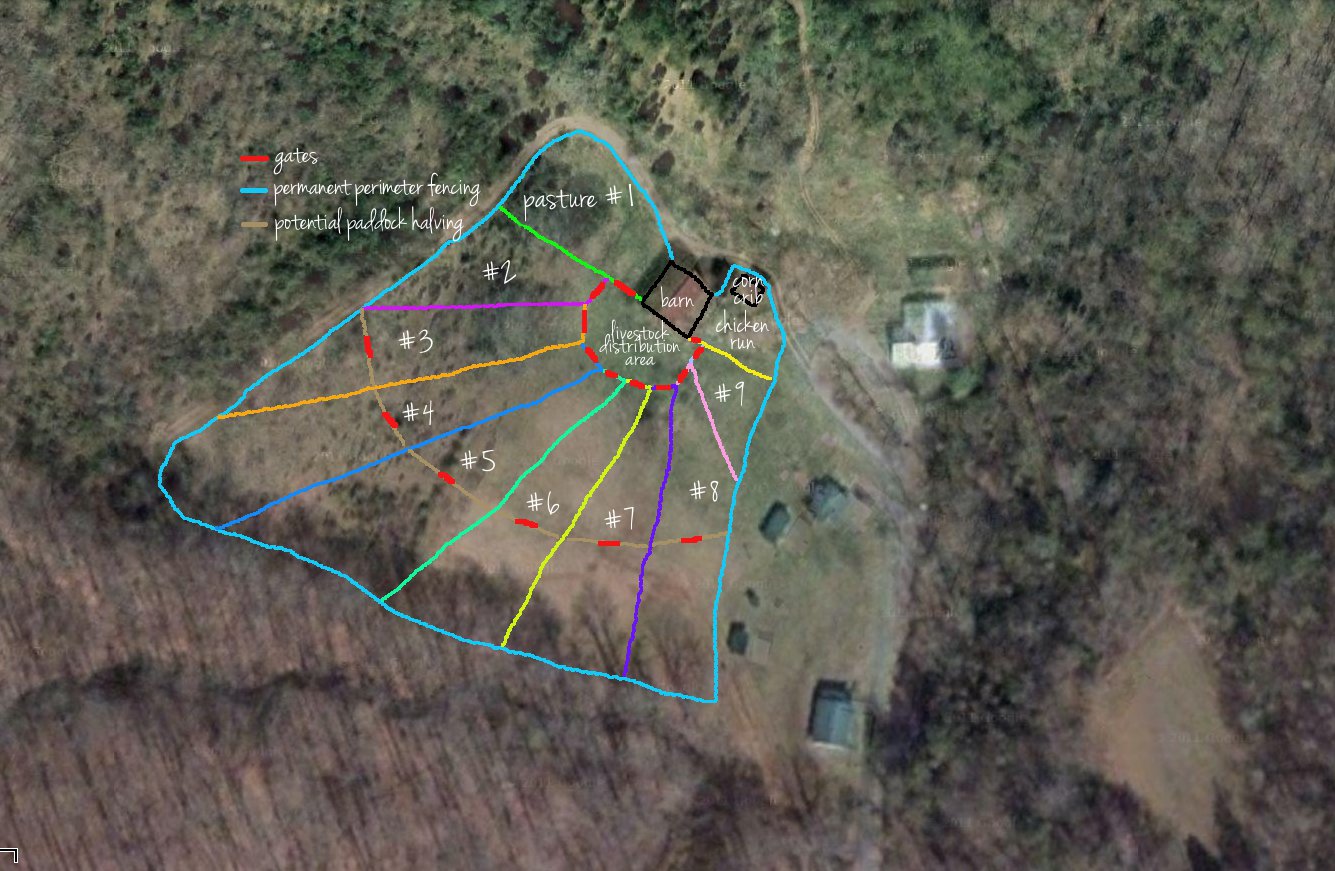
I know I'm getting way ahead of myself here, but the planner fanatic in me is taking over my brain and trying to figure out what might be the best way to fence our pasture into individual paddocks for rotational livestock grazing.

Trying to determine what fences should go where when we're not totally sure how many animals we even want yet seems like a futile effort, so my thought process is to design a master plan that will allow us to build paddocks as we need them utilizing the placement of our turn-of-the-century barn that also permits design modifications if it just doesn't work well in real life like it does on paper.

Best to enlarge this so you can read my anal-retentiveness. Yea, I like pretty colors.

We think that it might be wise to use the old corn crib as a chicken coop. The chickens would have their own run (for when we're lazy and don't want to herd them into a paddock), but this design would also let us turn them loose to graze (do chickens graze?) with the cattle and/or sheep. The cattle and sheep eat and poop, and the chickens follow behind eating bugs and spreading the cattle/sheep manure around as well as adding their own. I'm not totally clear on the details of mob grazing yet, and I'm not sure that we want to have as many animals as what is needed for that method, but I imagine this layout or some variation of it will allow us to still rotationally graze at least.

So once the livestock has grazed one paddock, however long that takes, we move them into the next paddock and let the previous one recover for however long is needed for it to grow back. This may mean that the paddocks need to be much smaller than what I have outlined (hence, the "potential paddock halving" lines on my illustration), but my math skills suck and I'm not going to even pretend that I want to calculate livestock consumption needs versus what we have available (my brain hurts already), so we'll only know that once we start actually grazing our livestock. Trial and error! We are open to the fact that we might need to actually go buy some hay, but we definitely like the idea of not having to buy supplemental feed, which I think justifies my ridiculous over analysis.

By the way, I'm going to call this the Mitsy's Bitchin' Sunburst Paddock Design because it reminds me of that cool stylized Japanese sunburst/sunrise art. Like this:

Vector-style pop art from a photograph of my hot hub playing shuffleboard down at the country club (July 2006).
I clearly knew that stylized Japanese sunbursts would someday make their way into my paddock plan.

Using the handy Planimeter site courtesy of ACME as well as the Tennessee Property Viewer site, I estimate the amount of permanent perimeter fencing needed to fence in our grownup pasture area to be approximately 1,500 linear feet. Jay's brilliant idea is to follow the already carved out treeline that borders this area in order to save on fence posts and what not. We've already discovered this method used on our property with some old fencing that is no longer usable up on the ridge, so if it worked for whoever installed it way back in the day, we don't see why it wouldn't work again.

Temporary, movable cross fencing is less expensive than permanent fencing, but based on this design, I estimate the cross fencing will total at least 2,600 linear feet, including my "potential paddock halving" (about 2,200 without). My design also includes 16 gates. My gut tells me that we're gonna be building a lot of our own gates to save on costs. I have purposely focused on livestock breeds that are relatively easy to contain and happy to graze within their confines without much fuss. I've read that Highland cattle are so docile that they really only need single-strand electric fencing.

Which brings me to my next point: goats. Goats are escape artists. They can unlock gates and hop fences and shit. I'm a huge animal lover and proponent of ethical animal husbandry, but I want livestock to eat, not chase around our farm. I'd rather get my cute dose of the day from animals that I can reliably control. Like dogs and cats. So no goats. I say that now, lol

I learned yesterday that pigs really like, among other things, chestnuts. We have a big ass chestnut tree in the field where the old farmhouse used to be. As in, almost as big as the barn! So it would make sense to put some piggies there where they can fatten up on chestnuts and till the soil for me for future garden space.


Then if we need to move them somewhere else, I'd like to try fencing in some woods so that they can clear the underbrush and create a pretty forest setting so I can do something like this:

Wishful thinking, I know.

This design also assumes that we will use the barn to house the animals instead of just throwing some make-shift animal shelters out there. I haven't yet figured out how rotational grazing might work with that method. Would we have to move the shelters into each new paddock or would the animals accept a new shelter every time we moved them?

So, yea, that's a lot of fence. Lotsa fence = $$$$. But my clever design will hopefully allow us to build our fences as we add more animals and as we can afford it. Even the permanent perimeter fencing could wait to be installed if money is tight.

I'd be so lost without aerial imagery.

Wednesday, February 1, 2012

clinch river beauty

I can't WAIT to float this baby in the summertime...

I think my innertube will tie up very nicely on that thar tree...

Our friends own this killer riverfront parcel.

We could probably walk home if we got all pickled down by the river. But it would be a very long walk.

That tree on the left looks like it's flinging its arms out to keep from falling down the mountain.
I see strange things in nature sometimes.

Tuesday, January 31, 2012

future farm critters - part 3: sheepies

There's a lot to farm animals that kinda scares the crap outta me, like de-worming medications and susceptibility to parasites and poor mothering skills and finicky eating habits and hoof rot. I really don't want to get farm animals that I am ill-equipped to care for due to misinformation on my part, stupidity, fear, or just plain bad luck. One of my favorite blogs to read is Farmgirl Fare - I love Farmgirl Susan's blunt honesty about farm life coupled with charming photographs that were just enough to whet my appetite for a farm of our own - but the trials and tribulations that she has talked about in detail sometimes make me want to just become a vegetarian again and forget all about raising our own meat.

Fortunately, I'm lucky to have a partner in crime that shares my lust for all things related to self-sufficiency and is not a sissy like me when it comes to the not-so-fun stuff. When I first started backyard homesteading (if you can really call it that), I was determined to cut the head off my first home-grown chicken to prove to myself that I really could pursue such an existence on a grander scale. But I much prefer to have Jay do it because his aim is better than mine, and besides, I still do the plucking and gutting and carcass dressing and cooking and what not.

So I figure we should try to tip the odds of homesteading success in our favor by focusing on breeds that are relatively fool-proof and don't require a lot of input on our part. I previously reviewed the merits and applicability to our future homestead of Scottish Highland cattle and Ossabaw Island as well as Red Wattle hogs, and I've pretty much decided which breed of sheep would likely suit our situation best: St. Croix hair sheep.

I adore this scene and wish to replicate it in its entirety. Well, maybe not quite so many sheep. But definitely the LGD.
[ image courtesy Five Ponds Farm ]

They're not really anything special in the aesthetics department, just white, although the boys do get a pretty rad lion's mane type thing that can grow all the way to the ground. Hair sheep don't produce wool and are bred primarily for their meat whereas wool breeds sacrifice meat quality for wool quality. I could care less about wool. I might take up knitting again someday, but that's pretty low on the totem pole. And the idea of shearing a sheep with sharp shears and possibly severely injuring myself or the sheep because I'm too stubborn to hire someone to do it is not a pleasant thought. Besides, hair sheep look funny when shedding their coats without any need for intervention from myself, and I'm always down for some free entertainment.

St. Croix sheep originally hail from the Virgin Islands, and I'm all about bringing a lil tropical flair to our Appalachian mountain backdrop.

But the big kicker is that if well managed, St. Croix sheep generally don't require any de-worming medication, which apparently is expensive and a pain in the ass to administer, and I've said time and time again that I'm lazy and don't want to be wrangling a sheep just to shove some medicine down its throat that it shouldn't need in the first place.

We, like, forage and shit instead of demanding hay like picky other sheep breeds. We RULE.
[ image courtesy Lenox Ranch ]

But I've read that even the most parasite-resistant sheep breeds sometimes still need some de-worming, so I hope to take Farmgirl Susan's advice and try to stick to a hippie garlic/apple cider vinegar concoction that supposedly really works in addition to using diatomaceous earth (aka DE). The combination of extremely hardy sheep and natural remedies will hopefully prevent us from ever having to buy some de-worming medication that I cannot pronounce the name of. Take that worms!

Lenox Ranch in eastern Kentucky says that they raise their St. Croix sheep on pasture alone with no supplemental feed, even in winter. This is what sold me on these guys. I'm confident that we have enough pasture to support enough lambs to fill our freezer. According to St. Croix Hair Sheep Breeders, Inc., they also have a high lamb survival rate, are good mothers, don't have horns to get caught up in fencing, and provide delicious meat.

We're not trying to run a major farm operation here. Our goal is not to make money farming but to provide food for ourselves. If we have bumper garden crops and are successful in breeding our stock that, in turn, generates an income, all the better. Which is why I feel extra blessed that we can be choosy in our farm stock and pick the best breeds suited to our needs instead of focusing on profits.

Next farm critter: goats!

~ Mitsy

Monday, January 30, 2012

flora and other farm prettiness

I was planning to do this series documenting each day during our last trip to the holler, which was back in late November/early December, but it is now almost February, and doing that seems totally retarded to me now. But because I still have more pictures from our trip that I wish to share, I will post some pictures of the local flora instead because I find it all magical and beautiful and shit and am getting some serious spring fever sitting at my desk over here in my windowless office.

So here you go:

Ridgeline view from the barn.

Weathered barn wood + sprinkling of clouds = happy Mitsy.

Jay is not flora, but he sure looks good in it.

I still trip out on being able to see through deciduous trees.

Kinda Sally-Mann-ish composition. She's from Virginia, you know! Or is it West Virginia. I don't remember.

gah, want. to. organize. NOW

Golden.

Purplish.

This image is out of focus. My bad.

Crunchy.
Tomorrow: Clinch River beautifulness.

Thursday, January 26, 2012

thinking too hard while i sleep

For the past few weeks, I've dreamt of the holler every single night. I may not necessarily recall the exact dream details (although I do have a knack for recounting my dreams, which sometimes tests Jay's patience with my incessant ramblings), but I do know that holler dreams pay me a visit regularly.

On Tuesday night, my dream was multi-faceted. It was somewhat shrouded in anxiety, probably because we've been discussing a lot lately when we might actually make it out there for our final move, which of course gets me incredibly giddy, not to mention makes me break out into full-blown planner craziness. Yes, I started planning our vegetable garden, fruit orchard, and bramble patch on paper (er, I mean Excel because my handwriting sucks balls and do you really think someone as anal-retentive as I am could make do with handwritten notes? pshaw).

I've started developing our future pasture renovation timeline.

I'm discovering which herbs are best inter-planted amongst my future annual vegetables for maximum disease/parasite/bug/fungus/whatever resistance and that will attract beneficial insects and butterflies.

I'm researching what hardy, perennial ground covers would do well for my future garden pathways.

I'm interested in learning more about hugelkultur, quick hoops versus greenhouses, and mob grazing. I haven't delved into bee keeping or forest gardening yet.

I study the aerial views of our property daily and think about how to make the lay of our land work best for all these projects that I think up.

Y'all, Mitsy McPlanner is quite the obsessive compulsive gal to be around these days.

Anyway, back to my dream:

We're at the cabin (Jay is always closeby in my dreams but not necessarily within view), but it's situated more on an east/west axis instead of the current north/south orientation and is slightly bigger. It's a sunny day.

Jay is in the driveway trying to pick something up off the ground when this very large tractor/heavy equipment type vehicle comes barreling up and brakes just in time to barely avoid hitting him. He greets the mail lady hello and continues to try to pick up the strange object.

There's a real estate agent showing someone the cabin interior, and I tell her that it's not for sale anymore because we bought it, and she responds that she just wants to show her client the woodwork (which isn't anything to write home about).

I'm now out behind the cabin, and there's a huge field that dips way down and up the mountain again - a big bowl of pasture of sorts. It's very pretty - the tall green grass seems to be sparkling and is swaying in the breeze - but I don't remember it being there before (our land only goes up the mountain from the cabin in real life).

I'm back inside and some person has left the kitchen sink running, and it is now overflowing. Anyone that knows me well can attest to my innate fear of overflowing toilets, sinks, and swimming pools. This fear plays a role in my dreams frequently. I still can't believe there's no name for this phobia - believe me I've looked.

The overflowing kitchen sink is red and shaped kinda like a heart and is surrounded with pretty glass countertops, which I think to myself is neat but can't look at any longer because I'm fleeing in fear.

Now out in front of the cabin, people are setting up a flea market of sorts to peddle their treasures. There are about five people with plastic tables littered with various knick knacks. I don't seem to mind this infringement on our privacy.

I look up the hill and someone has built a much bigger cabin and is waving from the front porch. On our land. Looking down on us. This infringement infuriates me!

THE END. Aren't dreams fucking weird?!

Friday, January 13, 2012

buying land in a poor area

[ warning, I blab a lot in this post ]

When relocating, people usually decide what amenities they can't live without and narrow their search to find their ideal location. Common requests include highly rated schools, a low crime rate, diverse shopping options, reasonable utility expenses, efficient transportation and communications options, and a decent entertainment scene (whatever that may entail). Although they may balk, all these amenities come at a price, usually in the form of higher property and/or income taxes as well as more bureaucracy, and most people grudgingly accept such trade-offs as necessary. Such a bucket list usually means that economically depressed areas get crossed off the list right away because poor areas usually have more drug use, a lower high school graduation rate, ineffective or nonexistent social services, a stagnant business climate (leading to few jobs), and perhaps community eyesores/trashiness that are not acceptable in certain minds. People that are relatively well off can't envision themselves downgrading their standards and people less fortunate are usually looking to improve upon what they see as a lower standard of living if at all possible.

Our relocation needs differed vastly from the majority of folks:

1) Our number one requirement was to be in the  mountains and live in a scenic setting surrounded by nature and abundant natural resources. We had to have fertile soil, a plentiful water source, and lots of solar gain (aka, a predominantly south-facing parcel). We wanted a large chunk of acreage, with privacy being paramount, thus allowing us freedom to focus on whatever homesteading projects we dream up while encountering as little bureaucracy as possible.

2) Kids are not in our future, so good schools were irrelevant (although some may argue that good schools still benefit the child-free in the form of less crime, a better educated workforce, etc).

3) While I do like to shop, I don't mind driving an hour or two to get there (adventure!), and homesteading will inherently mean doing much less food shopping, and most other shopping can be done online (therefore, we did need to be able to have UPS find us).

4) We rarely patronize traditional entertainment venues, such as bars, movie theaters, bowling alleys, and so forth, although we do like to find honest restaurants and I love me a classic festival with vendors and carnival food (fortunately, southern Appalachia has many!). I'll take a scenic mountain backdrop, clear flowing river, or flowering meadow any day over cultivated entertainment.

5) We were prepared to trade off common conveniences, such as indoor laundry, automatic dishwashing, and supermarket prepared foods, for independence in the form of hand-washed and line-dried clothes, good conversation while washing and drying dishes, and growing, hunting, and preserving food that comes from our own land. One convenience that was still essential to us, however, was decent communications, and although we don't have a land line for DSL or cable internet at the holler, we plan to use our cell phones as hot spots for our internet connection (we haven't had much luck finding a device that boosts our signal enough, but we haven't given up hope yet).

6) Utilities had to be inexpensive, and we wanted to be able to explore alternative energy and waste options, such as composting toilets, solar capture, and rainwater catchment.

7) While no one wants to live in a high crime area, petty crime is a lot different than violent crime, and we understood that petty crimes, such as thievery and drug use, generally accompany poor areas as a result of desperation. We were really not concerned with being able to defend our homestead if the need ever arose. And being a good neighbor goes a long way in rural areas since people are more likely to keep an eye out for you when you treat them with respect.

8) Plentiful and decent paying jobs are usually the biggest concern for most folks. In our case, we are intentionally slowing down, simplifying, and embracing frugality in exchange for independence from the financially-fueled world. Expenses are still very real, but our goal is to diversify our income stream using our current skills, decrease our spending substantially (not having kids makes that a lot easier), and attempt to live off our land as much as possible. Jay and I feel pretty confident that we will be able to keep food on the table, a roof over our melons, and maybe have a little fun money to spare. Only time will tell how successful we are, but this is not something new, and many people have successfully transitioned from full-time employment and high-expense households to voluntary simplicity.

Inserting a picture here to keep your attention in case you're bored outta your mind with my ramblings.

Hancock County is the poorest county in Tennessee and the 27th poorest county by median income in the United States (as of 2010). In order to be able to try out each income-producing pursuit that we've tossed around and find the one(s) that work best, we've decided to start saving now and hope to have enough of a nest egg to cover our mortgage, utilities, and food requirements for two years once we move to the holler. We have no other debt than our mortgage, and not having to worry about basic living needs should allow us to focus our energy on building our income survival base, and when the time comes to start living off our income instead of savings, we'll be able to transition relatively easy.

There's always the possibility that we will fail miserably at all our money making pursuits and end up working at the local fast food joint, but even if that happens, we should still be able to survive.

I can't find the link, but I read somewhere about the benefits of buying in an economically depressed rural area, a few of which include: low property tax rates (due to few services), a strong sense of community (everyone has gotta band together to survive), inexpensive property, a small population density ratio, and a general freedom to do whatever you want (as long as you're not negatively affecting anyone else). I find this last benefit the most interesting and applicable to homesteading life.

Few restrictions means that you are able to make your land work for you instead of the other way around. More specifically:
  • Growing food in the form of vegetables and meat instead of buying someone else's (your garden doesn't have to be pretty to impress the neighbors - but it probably will be anyway!)
  • Harvesting precious water, either by spring/creek/river, ponds, or rainwater catchment, instead of paying a utility company.
  • Harnessing solar power for the use of modern electric conveniences and eventually perhaps disconnecting from the grid.
  • Collecting downed trees and growing new ones for firewood.
  • Using animals and their natural instincts/skills for homesteading chores (goats for clearing, pigs for tilling soil, dogs for protection, cats for rodent control, and so on).
  • Using wildlife to sustainably fill your freezer and keep the local ecosystem in check (aka, deer population control).
  • Caring for your land in the manner that works best for your family and the critters that help make survival possible.
  • Caring for your neighbors and the community at large by sharing your excess goods when possible and helping those in greater need than you.
Let's all say a collective "Awwww!"
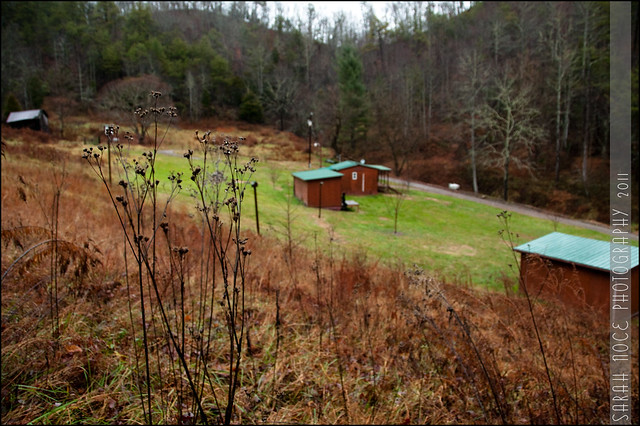
Still with me? Awesome possum.

Now granted, you could probably do a lot of these things in a better economic suburban or even urban setting, but being out the sticks has one huge advantage: people leave you alone (for the most part). Unless you're being an ass about something, no one cares what you do. They don't mind your ugly new DIY solar contraption (since they can't see it), your barking dogs (you're far enough away from them after all), the [insert farm animal here] that occasionally escapes their confines (since you'll probably share the bounty with them at slaughter time), a few gunshots here and there (venison anyone?), the occasional burn pile that may have questionable burnable items, or the pick up truck that finally bit the dust and has now become yard art. They might even get a chuckle out of your attempted homesteading projects and aspirations and decide to help you out when you can't figure out how to milk your new goats. But the bottom line is that I see the above attributes as essentially helping one to become financially and socially independent (to a certain degree), and that is a very important goal to Jay and myself.

We bought a property that spans an entire box canyon all the way up the mountain for a few reasons, two of which I've already mentioned: privacy and defensibility. I realize the latter sounds a bit paranoid, but I don't want to have to get another landowner's permission in order to be able to fend off zombies in the coming apocalypse. Kidding! sorta

Privacy is paramount as well. I want to be able to take a pee right there when I'm in the middle of a gardening chore, skinny dip in our to-be-dug-in-the-future pond, hoard supplies for future projects without worrying about neighborhood aesthetics (in a tidy and organized manner of course), and have a place to bury the bodies. Kidding again! yes, I really am this time

All this is a really long-winded way of saying that we know we're weirdos and have strange aspirations that might not jive with societal expectations, but there is a rhyme and reason to our thinking, and I hope that maybe others out there can be inspired to think a little differently when it comes to determining what is important in life. This is all new to us, and I may read this post five years from now and chuckle at our naïveté, but hey, life is an adventure, and it would be pretty boring if everyone wanted to live in picture perfect neighborhoods, drive new cars, and spend eight hours working for someone else every day (which both of us do now, by the way).
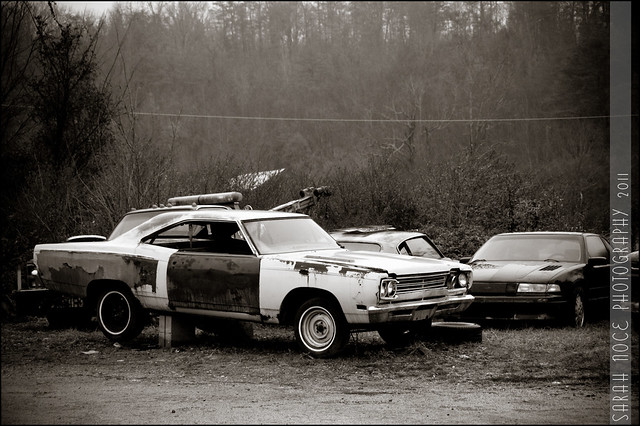
Mitsy thanks you for reading through to the end by rewarding you with an image of some yard art.
Junkyards can be hauntingly beautiful, you know!

Thursday, January 12, 2012

day 2 at the holler

It certainly was frosty on our second day back at the holler.

Crunchy grass.

The dinner bell. Yea, we have a freaking dinner bell!

But then the sun creeped over the ridge,
and everything was right with the universe.

We ventured out via automobile on back roads. Top of our ridge as seen from Virginia.

Then we got some lunch at Pal's Sudden Service in Kingsport and ate delicious chili dogs and burgers and peach tea.

Found the nearest package store and stocked up on whiskey.

Our new memory foam mattress and petite sofa had arrived when we returned
(sorry we were late Mr. Delivery Man From Knoxville, whoops).

Our wood stove works well. Like let's-get-to-100-degrees-in-2-hours well.
We actually had to open all the windows and doors in
20-degree weather to cool the cabin down a bit.

I think it was that night that we agreed our two-year time frame for moving out to the holler was just way too long. 2012 sounds much better.

more manana, my peeps...

~ Mitsy

Tuesday, January 10, 2012

future farm critters - part 2: piggies

Two breeds of porkers that we like the sound of are Ossabaw Island and Red Wattle/Waddle hogs. First we'll talk about the Ossies (yes, I coined that phrase just now).

Spotted, hairy piggies make me squeal.
[ image courtesy Nature's Harmony Farm ]

Apparently, a bunch of Spaniards left these guys to fend for themselves on an isolated piece of dirt in Georgia called Ossabaw Island. Because they were feral, the breed stayed pretty small (about 200 pounds market weight), forages well, and will drink just about anything. They'll root up all sorts of shit, so best to put them someplace where you want to take advantage of that, like out in the woods or in a new garden area or whatever. My garden is pictured below with me in the background hoe-ing away.

YEAH. RIGHT.
[ image courtesy Country Living ]

I could only hope for a fraction of the beautifulness of this garden.

Anyway, Ossies are supposed to be pretty independent. (We like independent. I'm lazy.) They're supposed to be excellent mamas and have an extremely high healthy birth rate. (Because I don't want to have to help a pig give birth, I ASSURE YOU.)

And tasty, too. Because although I have no experience with slaughtering swine, this will be the end result, and I love me some bacon and chops. And ribs. And sausage.

In direct contrast, Red Wattle hogs are BIG. Like 1,200 pound market weight big. And they get big fast because they're lazy. Their exact origin is unknown, but they might originally be from Australia. Ossies (my newfound word) + Aussies = clearly a sign that we should raise both. They're good mamas, too, and have crazy appendages that I find weirdly charming hanging off their cheeks, hence, the wattle descrip.

Wattle: the appendix equivalent of pig facial features.
[ image courtesy porkfoodservice.org ]

I don't care if they're edible, though, I'm not eating the wattles.

The Ark of Taste describes the Red Wattle hog as "...known for their hardiness, foraging activity, and rapid growth rate. The sows are excellent mothers, who labor litters of 9-10 piglets, and provide good quantities of milk for their large litters.  They adapt well to a wide range of climates, making them a good choice for consideration in outdoor or pasture-based swine production. Red Wattle pork is exceptionally lean and juicy with a rich beef-like taste and texture."

That last line is what has me sold. Next in the future farm critters series (but not necessarily the next post because, holy smokes I have some holler pictures to show off): St. Croix sheep!

over and out, hoeboats

~ Mitsy

Thursday, January 5, 2012

future farm critters - part 1: cattle

So, I've been super bogging on posting because I have a crapload of pictures I want to show y'all from our Nov/Dec trip to the holler, but I've also been slacking on processing said images, and it's become a vicious cycle of me hating on myself for not finishing them yet and feeling guilty for not having posted anything since... ahem... December 11th.

So today, I brilliantly remembered (dingdingdingding!) that I could quite possibly talk about some other subject instead of worrying about those damn pictures so much. Until I finish them at least. There's really not that many (a hundo or so), but being the OCD weirdo that I am, I must ensure that they meet my processing standards. Crackheading out over here.

I consulted my trusty "blogging ideas" list on listhings.com (hello digital post-it hell) and randomly picked today's subject matter:

Animals we'd like to keep.


What an original title.

Browsing through my Pinterest homesteading board (image bookmarking HEAVEN, people), there are a few varieties of heritage livestock breeds that we're particularly interested in. See, we're new to this whole homesteading thing (and only currently in the backyard homesteading stage instead of the full-fledged homesteading we-are-hillbilly-farmers stage), and although I feel mildly successful thus far with our chicken shenanigans (which, by the wayside, has become annoyingly trendy and I feel a bit robbed of my purported weirdness among family, friends, and strangers alike, although they were still shocked and a bit disturbed when I brought a home-grown hen to the Christmas brunch table, freshly butchered, dressed, and cooked that morning, which made me feel better - and yea, every last piece of that thing was scarfed down), I would still like to start out with easy breeds in each type of farm animal. wtf, run-on sentence

Heritage breeds are supposedly better adapted to the homesteading lifestyle: better resistance to parasites/worms/etc, able to mostly fend for themselves, slower growing, friendlier, and all around more independent than breeds cultivated for specific traits. I love caring for and tending to animals, but the more self-sufficient they are, even if that means trade-offs in the form of less end product (meat, milk, whatever), the better in my mind.

So without further ado, here's a few of our faves:

Holy cuteness, Batman, amiright?!
[image courtesy Dreugans Molach Farm]

Now, I realize that baby animals probably aren't the best method with which to decide breeds, but I'm pretty sold on these Scottish Highland cattle. We really kind of want to fulfill that farm ideal of having a cow, but our pasture areas are somewhat limited (more on our usable acreage in a future post, aka, further procrastinating on trip pictures), and these bad boys are A) on the smallish side B) forage well and aren't picky about having picture-perfect fescue (or whatever the hell it is that cattle like to eat), C) give delicious meat and so-so milk (plan to get milk from goats anyway [edit: not anymore!]) and D) are fuzzy and rad looking!

In case you forgot how fucking bad-ass these guys are.
[image courtesy Dreugans Molach Farm]

We would probably start out with just a female because I've heard female stock are generally easier to keep than males (figures) and then get some bull's swimmers put in her (aka, artificial insemination) and see what we end up with for a baby cow. Then figure out if we keep the offspring for meat or further procreation or sell it for a buck or whatever. Lots of logistics involved, but I figure we'll have plenty of time to sort out those details when the time comes. I know that most farm animals prefer to have a buddy, but cows don't necessarily need a partner of the same species, especially if they have other farm buddies like goats and sheep and chickens running around. Getting two sounds a bit daunting until we figure out what the hell we're doing.

Heritage breeds can be a bit more difficult to find than standard stock breeds, but I figure we'll welcome the opportunity to explore and take road trips to find our future farm critters.

And in case you forgot again:

I might have a hard time eating them.
[image courtesy Windy Acres Farm Shop]

Next: piggies!